
A Briefing on S 2.14, S 2.15, and TPTTBS Reports
The Banque centrale du Luxembourg (BCL), in alignment with European Central Bank (ECB) directives, has established a multi-layered statistical reporting framework for Securitisation Vehicles (SVs). This framework is designed to provide comprehensive data on SV assets, liabilities, and transactions for analytical and research purposes.
Compliance requires the submission of three distinct, interconnected reports:
- Monthly TPTTBS – Security-by-Security Report
- Quarterly S 2.14 – Statistical Balance Sheet
- Quarterly S 2.15 – Transactions and Write-offs / Write-downs Report
The primary operational challenge lies in the extreme complexity and granularity of these requirements, particularly within the TPTTBS report. A critical distinction is made between securities identified by an ISIN code and those without, with non-ISIN securities requiring a significant volume of supplementary data, including issuer details and coupon characteristics.
Reporting entities face strict deadlines, with both monthly and quarterly reports due within 20 working days of period end. The intricate validation rules and reconciliation requirements across reports create a substantial compliance burden. An automated and specialized solution, such as Fund XP, is essential to manage data aggregation, enrichment, validation, and submission efficiently.
BCL Reporting for Securitisation Vehicles, Simplified
Fund XP provides a dedicated, automated regulatory reporting platform designed specifically to address these challenges.
Our Excel-based reporting solution covers the three statistical reports every Luxembourg securitisation vehicle must file with the BCL — the quarterly balance sheet (S 2.14), the write-offs report (S 2.15) and the monthly security-by-security report (TPTTBS) — in one single workbook with a shared header. Every cell you type is validated in real time against the BCL verification rules: ISIN check digits and forbidden prefixes, country and sector codes, coupon consistency, mandatory breakdowns and duplicate lines are flagged instantly, with the faulty cell highlighted and a plain-language message explaining what to fix.
- Check & blocked export — a one-click global check re-validates every row, and the XML simply cannot be generated while errors or missing mandatory fields remain: what leaves the workbook is right the first time.
- Valuation Update — refresh all monthly figures from a single CSV or Excel extract; securities are matched automatically, ISIN or not, and your static data stays untouched.
- Month-over-month comparison — load last month’s XML and get an instant variance report with configurable alert thresholds, the same plausibility view the regulator applies.
- Cross-checks between reports — the monthly TPTTBS security totals are automatically reconciled with the corresponding S 2.14 quarterly lines, the exact consistency controls the BCL runs on reception, so discrepancies are caught before filing, not after.
- Smart data entry — selecting an item pre-fills the codes the BCL imposes (issuer country and sector for own issues, fixed breakdowns, zero-coupon consistency), so most cells are typed for you and forbidden combinations never reach the file.
- Built-in contextual help — hover any column title to see the applicable BCL rule, the allowed values and a concrete example, straight from the official manuals.
- Native XML import/export — files are validated against the official BCL schemas before saving, named to the eTransmission convention, and previous reports can be re-imported to start a new period in seconds.
- Optional direct transmission — send the generated report to the BCL from the workbook itself, over an encrypted channel, without leaving Excel or handling the secure file transfer separately.
- Nothing to install — a standard Microsoft Excel (Windows) workbook: no software deployment, no IT project, no dependency on a specific secure channel. Duplicate the file to manage as many vehicles as you need.
The solution is designed for corporate service providers, fiduciaries and management companies handling BCL statistical reporting for one or dozens of securitisation vehicles — whether the figures come from an accounting system extract or are captured by hand.
The benefit is measured in rejected files that never happen and afternoons you get back: less manual capture, no round trips with the BCL, and a monthly filing that becomes a fifteen-minute routine instead of a day of double-checking. Contact us for a demonstration.
1. Overview of the BCL Reporting Framework
The BCL’s statistical reporting regime for SVs is governed by ECB Regulation (EU) No 1075/2013.
The framework mandates data collection from a representative sample of securitisation vehicles selected by the BCL to account for at least 95% of total SV assets in Luxembourg. The obligation applies to all SVs, regardless of:
- Legal form
- Supervision by the Commission de Surveillance du Secteur Financier (CSSF)
Core Statistical Reports
The reporting structure consists of three core reports, each providing a different level of insight into an SV’s financial position and activities.
| Report Name | BCL Code | Frequency | Deadline | Core Function |
|---|---|---|---|---|
| Security-by-security reporting of securitisation vehicles | TPTTBS | Monthly | 20 working days post month-end | Granular, position-level detail for security holdings and issuances |
| Quarterly statistical balance sheet of securitisation vehicles | S 2.14 | Quarterly | 20 working days post quarter-end | Aggregated balance sheet overview |
| Transactions and write-offs/write-downs on securitised loans | S 2.15 | Quarterly | 20 working days post quarter-end | Net transactions and loan valuation adjustments |
Interconnection of Reports
- TPTTBS data must reconcile with S 2.14 aggregated balances
- S 2.15 explains movements between balance sheet reporting dates
2. Deep Dive into Reporting Requirements
2.1 Report TPTTBS – The Granular Core
The TPTTBS report is the most detailed and operationally intensive component of the framework. It requires a line-by-line declaration of specific asset and liability positions.
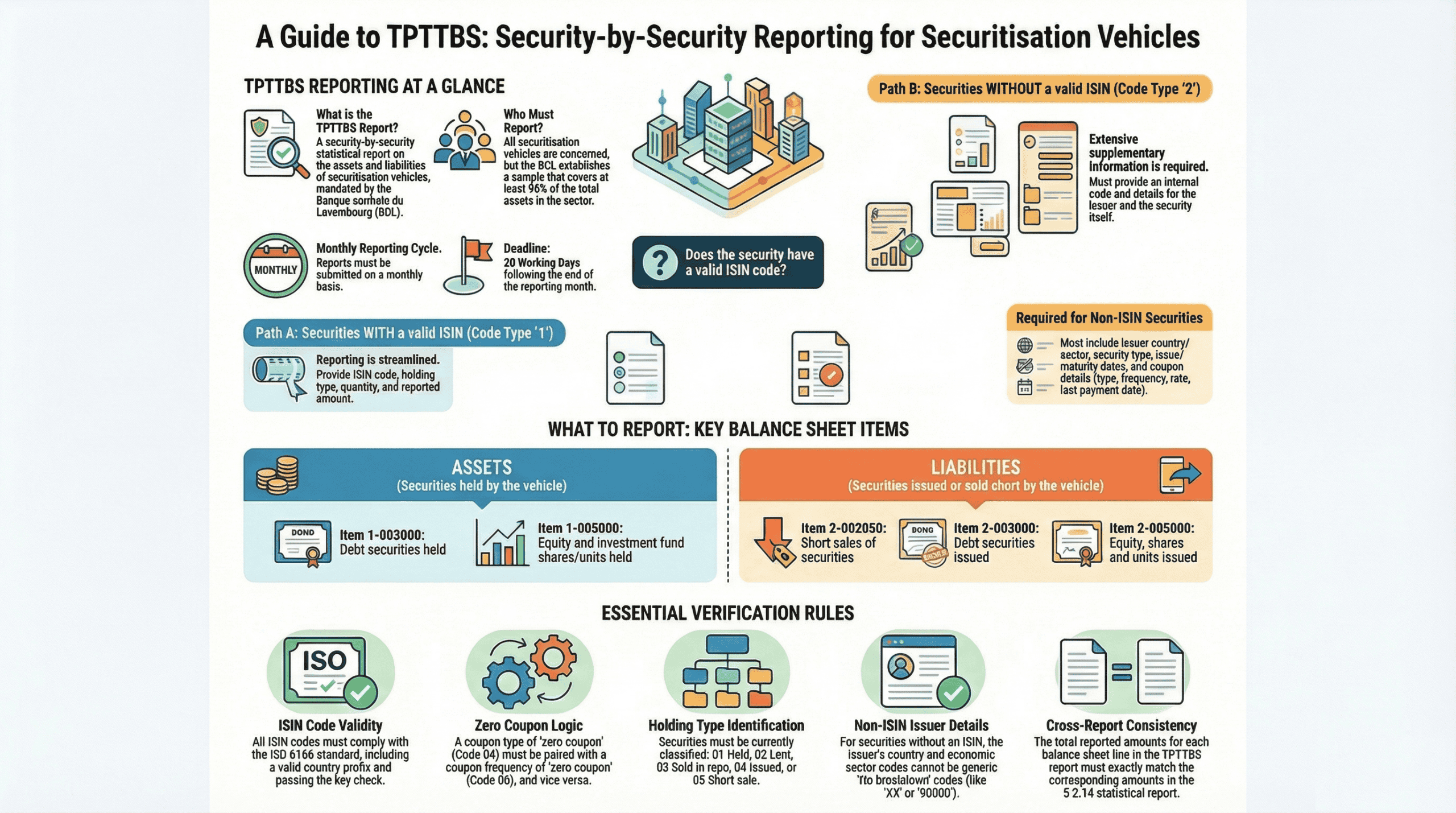
Scope of Reporting
Assets
- 1-003000: Debt securities held
- 1-005000: Equity and investment fund shares/units held
Liabilities
- 2-002050: Short sales of securities
- 2-003000: Debt securities issued
- 2-005000: Equity, shares and units issued
ISIN vs. Non-ISIN Securities
The central complexity of the TPTTBS report is the strict bifurcation based on the availability of a valid ISIN code.
Securities with a Valid ISIN (Code Type “1”)
Reporting is comparatively streamlined and includes:
- Identification: ISIN code
- Holding type:
- 01 – Standard holdings
- 02 – Securities lent
- 03 – Repo sales
- 04 – Securities issued
- 05 – Short sales
- Quantity:
- Nominal amount for percentage-quoted securities
- Number of units for currency-quoted securities
- Valuation:
- Reported at market value
- Debt securities valued using the dirty price (including accrued interest)
- Custodian: ISO country code of the custodian bank
Securities without a Valid ISIN (Code Type “2”)
When no valid ISIN exists (including provisional or pseudo-ISINs), extensive supplementary information is mandatory.
Common Requirements
- Internal security identifier
- Security name and currency
- Issuer country and economic sector
- “No breakdown” codes XX and 90000 are not permitted
Supplementary Data for Non-ISIN Debt Securities (Type “F.3”)
| Data Point | Description |
|---|---|
| issueDate | Full issue date |
| finalMaturityDate | Final maturity date (01.01.2999 for perpetuals) |
| poolFactor | Percentage of principal remaining (default 1) |
| couponType | Fixed, floating, zero coupon, etc. |
| couponFrequency | Annual, semi-annual, monthly, etc. |
| couponLastPaymentDate | Date of last coupon payment |
| couponRate | Annualized rate at reporting date |
Supplementary Data for Non-ISIN Equity / Fund Shares
(Types F.511, F.512, F.519, F.52)
| Data Point | Description |
|---|---|
| securityType | Equity or fund classification |
| dividendAmount | Dividend as % of reported amount (issued equity) |
| dividendLastPaymentDate | Date of last dividend payment |
| splitDate | Date of split or reverse split |
| splitRatio | Split (>1) or reverse split (0–1) ratio |
2.2 Report S 2.15 – Tracking Quarterly Changes
The S 2.15 report captures movements during the quarter, distinguishing between transactions and valuation effects.
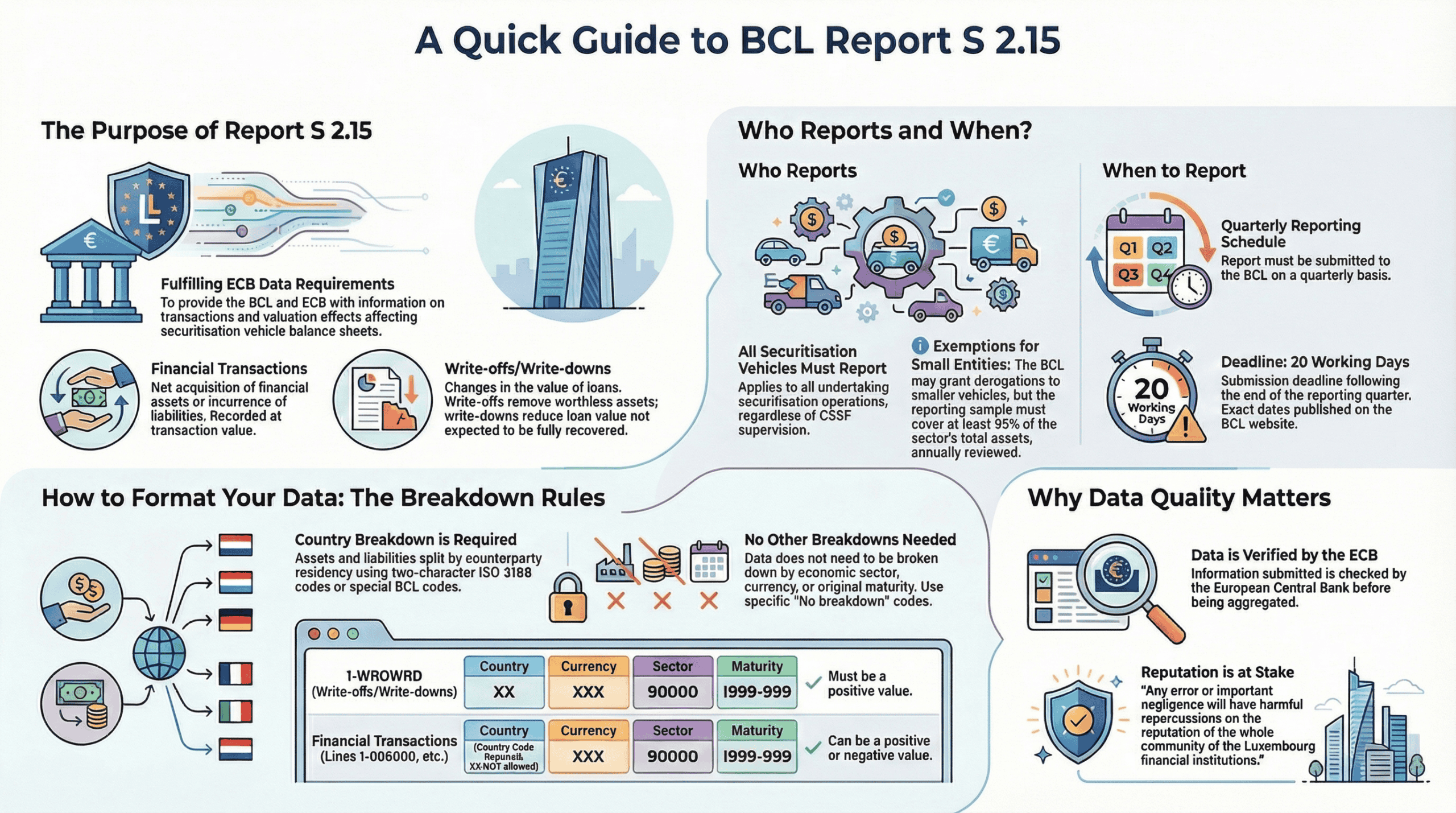
Financial Transactions
Definition:
Net acquisition of financial assets or net incurrence of liabilities, recorded at transaction value.
Applicable Items
- 1-006000: Non-financial assets
- 1-007000: Financial derivatives (assets)
- 1-011020 / 1-011040 / 1-011090: Other securitised assets
- 2-011000: Financial derivatives (liabilities)
Materiality threshold:
Valuation effects are required only if an item exceeds 5% of total SV assets.
Write-Offs and Write-Downs on Securitised Loans
Applies to securitised loans recorded under 1-010010 to 1-010060.
- Write-downs: Partial impairment of loan value
- Write-offs: Full removal of a loan deemed worthless
2.3 Report S 2.14 – The Aggregate Balance Sheet
The S 2.14 report provides a quarterly, high-level statistical balance sheet.
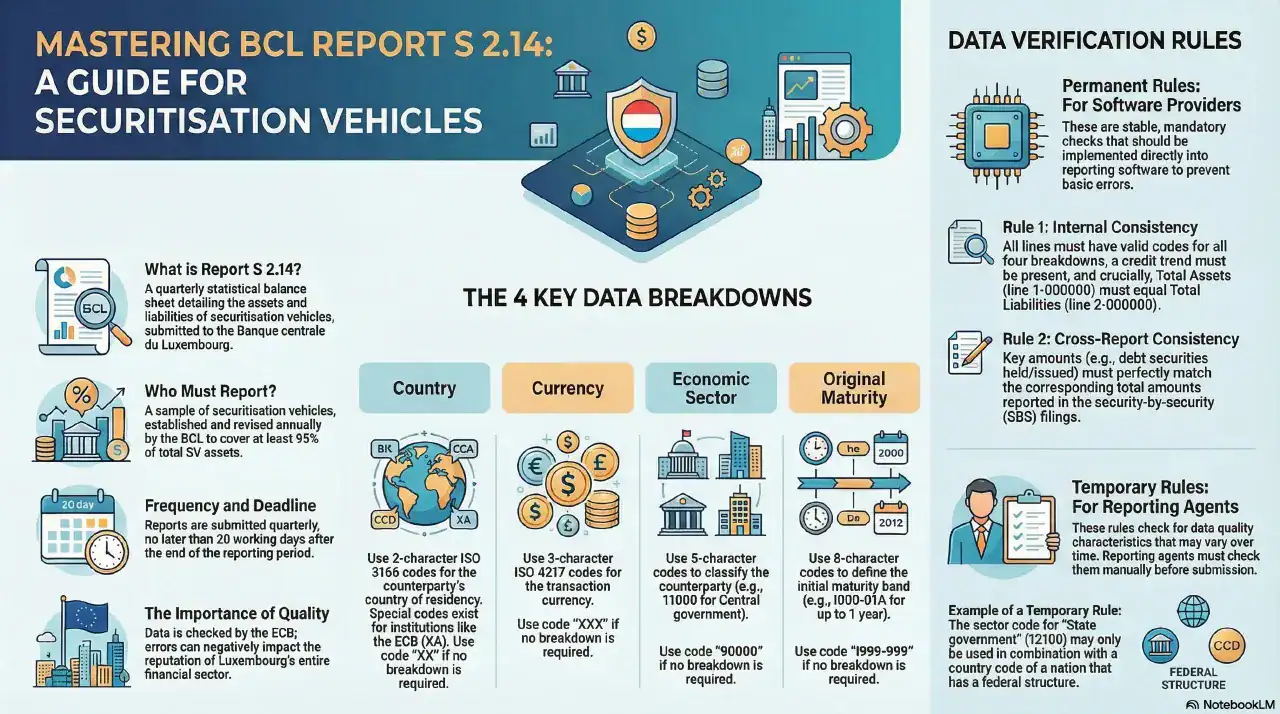
Breakdown Requirements
- Required breakdowns: counterparty country, currency, economic sector and original maturity, as imposed line by line by the S 2.14 matrix
- “No breakdown” codes (XX, XXX, 90000, I999-999) are only accepted on the lines where the matrix prescribes them — e.g. the total lines 1-000000 / 2-000000
- Consistency: total assets must equal total liabilities, and the securities lines must reconcile with the monthly TPTTBS
How Fund XP Mitigates Compliance Risk
Centralized Data Hub
- Aggregates data from portfolio, accounting, and custody systems
- Eliminates spreadsheet-based consolidation
Intelligent Data Enrichment
- Manages extensive non-ISIN data requirements
- Rule-based capture of issuer, coupon, and maturity data
Automated Validation Engine
- Applies BCL validation rules automatically
- Ensures reconciliation between TPTTBS and S 2.14
- Verifies codes, formats, and report structure
Workflow and Reporting Automation
- Manages monthly and quarterly reporting calendars
- Generates XML reports for electronic submission
- Maintains full audit trails for regulatory review
By leveraging Fund XP, reporting entities can transform BCL compliance from a high-risk, resource-intensive obligation into a controlled, automated, and reliable process—ensuring timely submissions while freeing operational resources for core business activities.
Discover our solution: https://fund-xp.lu/excel-to-bcl-reporting/
BCL website: https://www.bcl.lu/en/Regulatory-reporting/Vehicules_de_titrisation/index.html