
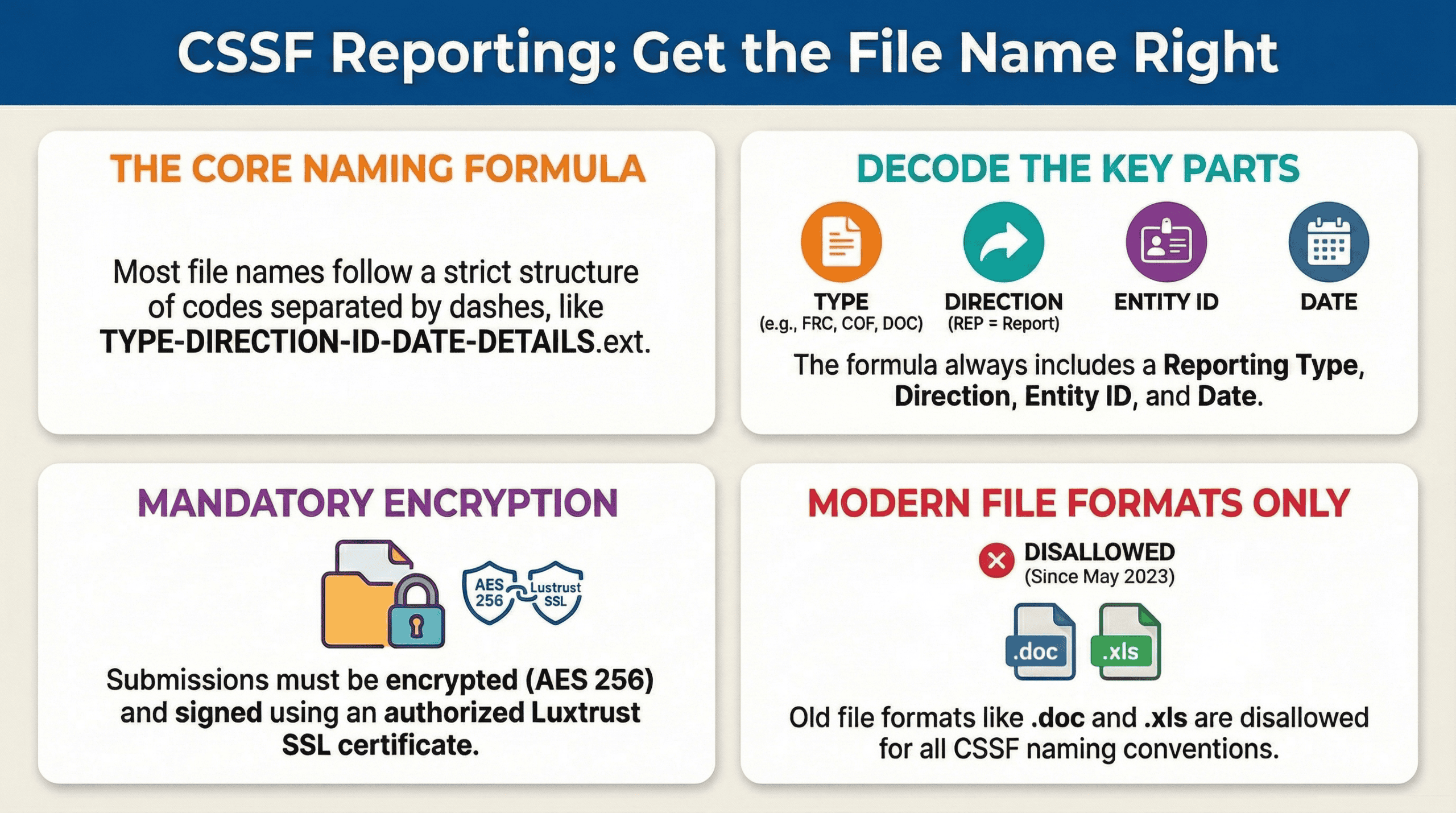
The Commission de Surveillance du Secteur Financier (CSSF) mandates strict and highly structured naming conventions for all structured data files transmitted via external channels, including efile and Sofie. Adherence to these protocols is not merely a procedural formality but a critical component of regulatory compliance.
This document serves as a definitive guide for reporting entities to ensure their electronic submissions are compliant, processed efficiently, and not rejected due to formatting errors. It provides a centralized summary of the required file name structures, the foundational technical prerequisites for secure transmission, and the automated feedback mechanisms used by the CSSF.
This summary covers the primary naming conventions for a wide range of report types. It does not, however, cover reportings for which dedicated user guides exist outside of this convention. To ensure successful data transmission, reporting entities must first meet a set of universal technical standards that underpin all submissions.
The Feedback Loop: Understanding CSSF Response Files
The CSSF utilizes an automated feedback system to inform reporting entities about the status of their submissions. These response files are essential for confirming successful reception or for identifying critical errors that require immediate attention. While feedback mechanisms can be granular, they fall into two primary categories.
FBR (Feedback Reception) Files
An FBR file is a systematic acknowledgement of receipt generated for all reportings submitted. Its function is twofold: it either confirms the successful reception and decryption of the report, or it informs the sender of a technical error that prevented the file from being accepted. All FBR files adhere to a single, standardized XML schema, regardless of the original report type. This is the universal, first-level response.
Application-Level Feedback (FDB, FBX, FBH)
After a file passes the initial reception stage, certain CSSF applications generate secondary feedback files to communicate the results of internal processing. While FBR confirms reception, these files confirm application-level status. The specific type varies by report:
- FDB (Feedback Application): A general feedback file indicating the results of business rule validations or data quality checks.
- FBX (Feedback XBRL): A specific feedback type, often a .zip file, containing the results of an XBRL validation.
- FBH (Feedback Handover): A feedback file confirming the transmission status of a report to a second-level European institution, such as the EBA or ECB.
Understanding these feedback files is key to managing the entire reporting lifecycle, from initial submission to final acceptance.
Detailed Naming Conventions by Report Type
This section provides a detailed breakdown of the unique and highly structured naming conventions for each major category of regulatory reporting. Following these formats with precision is mandatory for successful submission.
COF – RESOLUTION Reporting in XBRL
This convention applies to Resolution legal reportings submitted in XBRL format. Reports must be compressed into a .zip archive.
Important Note: As part of the COREP-FINREP framework, reporting through external channels like e-file or Sofie will be discontinued as of April 1, 2025. This convention will be obsolete after that date.
File Name Format:
TYRDIR-ENNNNNNNN-YYYY-MM-TTTTTT-LL-C-D-S.ext
| Code | Meaning | Structure | Authorised Values |
|---|---|---|---|
| TYR | Reporting type | Char(3) | COF |
| DIR | Direction | Char(3) | REP (Report), FBR (Feedback), FBX, FDB, FBH |
| E | Reporting entity | Char(1) | B (Banks), P (PFS – Investment firms) |
| NNNNNNNN | Identification number | Number(8) | 00000001…99999999 |
| YYYY | Year | Number(4) | Reporting year |
| MM | Month | Number(2) | 01 … 12 |
| TTTTTT | Table | Char(6) | SMRTLA, CMRTLA, MRTLAX, CRESOL, SRESOL, RESOLX, CFRXXX, CIRXXX, FMIRXX, LDRXXX |
| LL | Layout | Char(2) | 00 for all tables |
| C | Accounting version | Char(1) | L, N, S (EBA IND); C (EBA CON); P, E, O, R (SRB specific) |
| D | Final version | Char(1) | D, N, X, T |
| S | Sub-type | Char(1) | – |
| .ext | Extension | Char(5) | .zip for REP files, .xml for FBR files |
Instances within the .zip Archive:
The XBRL instance files inside the archive must be named
TYRDIR-ENNNNNNNN-YYYY-MM-TTTTTT-LL-C-D-S-NAME.xbrl
Validation Rule:
The core string TYRDIR-ENNNNNNNN-YYYY-MM-TTTTTT-LL-C-D-S must be identical for the .zip archive and all .xbrl instances it contains.
Example:
COFREP-B00000999-2024-12-RESOLX-00-L-T–.zip
DOC – Non-structured Electronic Documents
File Name Format:
TYRDIR-ENNNNNNNN-CCCCCCCC-PPPP-YYYY-MM-DD-DO-LL-IIII.ext
| Code | Meaning | Structure | Authorised Values |
|---|---|---|---|
| TYR | Reporting type | Char(3) | DOC |
| DIR | Direction | Char(3) | REP, FBR, FDB |
| E | Entity type | Char(1) | CSSF entity types (e.g., B, P) |
| NNNNNNNN | Identification number | Number(8) | CSSF identifier (or 00000000 if not yet known) |
| CCCCCCCC | Compartment number | Number(8) | 00000000 |
| PPPP | Unit type | Number(4) | 0000 |
| YYYY | Year | Number(4) | Document reference year |
| MM | Month | Number(2) | Document reference month |
| DD | Day | Number(2) | Document reference day |
| DO | Document type | Char(2) | AR, LF, CO |
| LL | Document language | Char(2) | ISO 639-1 |
| IIII | Annexe number | Number(4) | 0000+ |
| .ext | Extension | Char(5) | .pdf, .docx, .xlsx, .pptx |
Example:
DOCREP-B00000998-00000000-0000-2009-12-31-AR-DE-0000.pdf
EDP – Payment Institutions Reporting
This convention is designated for reporting by payment institutions.
File Name Format:
TYRDIR-ENNNN-YYYY-MM-TAB-LL-C-D-S.ext
| Code | Meaning | Structure | Authorised Values |
|---|---|---|---|
| TYR | Reporting type | Char(3) | EDP |
| DIR | Direction | Char(3) | REP, FBR |
| E | Reporting entity | Char(1) | Z (Payment institution) |
| NNNN | Identification number | Number(4) | 0001…9999 |
| YYYY | Year | Number(4) | Reporting year |
| MM | Month | Number(2) | 01 … 12 |
| TAB | Table | Char(3) | Z11, Z12, Z14, Z21, Z22 |
| LL | Layout | Char(2) | L0 |
| C | Accounting version | Char(1) | L, N, S, C |
| D | Final version | Char(1) | D, N |
| S | Sub-type | Char(1) | – |
| .ext | Extension | Char(5) | .xlsx |
Example:
EDPREP-Z9999-2011-03-Z11-L0-L-N–.xlsx
EME – Electronic Money Institution Reporting
This convention is designated for reporting by electronic money institutions.
File Name Format:
TYRDIR-ENNNN-YYYY-MM-TAB-LL-C-D-S.ext
| Code | Meaning | Structure | Authorised Values |
|---|---|---|---|
| TYR | Reporting type | Char(3) | EME |
| DIR | Direction | Char(3) | REP, FBR |
| E | Reporting entity | Char(1) | W (Electronic money institutions) |
| NNNN | Identification number | Number(4) | 0001…9999 |
| YYYY | Year | Number(4) | Reporting year |
| MM | Month | Number(2) | 01 … 12 |
| TAB | Table | Char(3) | W11, W12, W13, W14, W21, W22, W45 |
| LL | Layout | Char(2) | L0 |
| C | Accounting version | Char(1) | L, N, S, C |
| D | Final version | Char(1) | D, N |
| S | Sub-type | Char(1) | – |
| .ext | Extension | Char(5) | .xlsx |
Example:
EMEREP-W9999-2011-03-W11-L0-L-N–.xlsx
ESP – Special Enquiries
This convention is used for ad-hoc data requests and special enquiries from the CSSF.
File Name Format:
TYRDIR-ENNNN-YYYY-MM-TAB.ext
| Code | Meaning | Structure | Authorised Values |
|---|---|---|---|
| TYR | Reporting type | Char(3) | ESP |
| DIR | Direction | Char(3) | REP, FBR |
| E | Entity type | Char(1) | B, P, I, S, K, A, Z, W, etc. |
| NNNN | Identification number | Number(4) | 0001…9999 |
| YYYY | Year | Number(4) | Reporting year |
| MM | Month | Number(2) | Reporting month |
| TAB | Table | Char(3) | Defined per enquiry |
| .ext | Extension | Char(5) | .xlsx, .docx, .pdf |
Example:
ESPREP-B0999-2007-12-ESE.xlsx
FRC – COREP/FINREP Reporting in XBRL (Legacy)
This convention covers legacy COREP/FINREP reporting.
Important Note: As of April 1, 2025, COREP-FINREP reporting can no longer be submitted through external channels like e-file or Sofie.
File Name Format:
TYRDIR-ENNNN-YYYY-MM-TAB-LL-C-D-S.ext
| Code | Meaning | Structure | Authorised Values |
|---|---|---|---|
| TYR | Reporting type | Char(3) | FRC |
| DIR | Direction | Char(3) | REP, FBR |
| E | Reporting entity | Char(1) | B |
| NNNN | Identification number | Number(4) | 0001…9999 |
| YYYY | Year | Number(4) | Reporting year |
| MM | Month | Number(2) | 01 … 12 |
| TAB | Table | Char(3) | B24, B25 |
| LL | Layout | Char(2) | L0 (B25), L1 (B24) |
| C | Accounting version | Char(1) | L, N, C, S |
| D | Final version | Char(1) | D, N |
| S | Sub-type | Char(1) | – |
| .ext | Extension | Char(4) | .zip, .xml |
Validation Rule:
The core string must be identical for archive and XML instance.
Example:
FRCREP-B9999-2007-12-B24-L1-L-D–.zip
OPC – Fund XML Reporting
This convention applies to XML-based reporting for funds (Organismes de Placement Collectif).
Note: The E and IIIIIIII fields identify the sender (technical agent).
File Name Format:
TYRDIR-EIIIIIIII-TJJJJJJJJ-SSSSSSSS-YYYY-MM-DD-D-C-O-RRRRRR-LL.ext
| Code | Meaning | Structure | Authorised Values |
|---|---|---|---|
| TYR | Reporting type | Char(3) | OPC |
| DIR | Direction | Char(3) | REP, FBR |
| E | Sender entity type | Char(1) | A–Z, 1 |
| IIIIIIII | Sender ID | Number(8) | 00000001…99999999 |
| T | Fund entity type | Char(1) | O |
| JJJJJJJJ | Fund ID | Number(8) | 00000001…99999999 |
| SSSSSSSS | Compartment number | Number(8) | 00000000+ |
| YYYY | Year | Number(4) | Period end year |
| MM | Month | Number(2) | Period end month |
| DD | Day | Number(2) | 01 |
| D | Final version | Char(1) | N, D |
| C | Accounting version | Char(1) | L, N, S, C |
| O | Separator | Char(1) | O |
| RRRRRR | Table | Char(6) | O1.2__ |
| LL | Layout | Char(2) | 0_ |
| .ext | Extension | Char(4–5) | .xml |
Example:
OPCREP-B00000111-O11111111-00000000-2009-12-01-N-L-O-O1.2__-0_.xml
PSF – Reporting for PFS and Support PFS
File Name Format:
TYRDIR-ENNNN-YYYY-MM-TAB-LL-C-D-S.ext
| Code | Meaning | Structure | Authorised Values |
|---|---|---|---|
| TYR | Reporting type | Char(3) | PSF |
| DIR | Direction | Char(3) | REP, FBR |
| E | Reporting entity | Char(1) | P, I, & |
| NNNN | Identification number | Number(4) | 0001…9999 |
| YYYY | Year | Number(4) | Reporting year |
| MM | Month | Number(2) | 01 … 12 |
| TAB | Table | Char(3) | P11, P21, I11, I21 |
| LL | Layout | Char(2) | L1 |
| C | Accounting version | Char(1) | L, N, S |
| D | Final version | Char(1) | D, N |
| S | Sub-type | Char(1) | – |
| .ext | Extension | Char(5) | .xlsx |
Example:
PSFREP-P9999-2008-03-P11-L1-L-N–.xlsx
SGO – Management Companies Reporting
Important Note: As of July 1, 2024, submission of AIFM reportings via external channels has been removed.
File Name Format:
TYRDIR-ENNNN-YYYY-MM-TAB-LL-C-D-S.ext
| Code | Meaning | Structure | Authorised Values |
|---|---|---|---|
| TYR | Reporting type | Char(3) | SGO |
| DIR | Direction | Char(3) | REP, FBR |
| E | Reporting entity | Char(1) | S, A |
| NNNN | Identification number | Number(4) | 0001…9999 |
| YYYY | Year | Number(4) | Reporting year |
| MM | Month | Number(2) | 01 … 12 |
| TAB | Table | Char(3) | G21 |
| LL | Layout | Char(2) | L2 |
| C | Accounting version | Char(1) | L, N, S |
| D | Final version | Char(1) | D, N |
| S | Sub-type | Char(1) | – |
| .ext | Extension | Char(5) | .xlsx |
Example:
SGOREP-S9999-2009-03-G21-L2-S-N–.xlsx
SIC – SICAR Reporting
File Name Format:
TYRDIR-ECCCCCC-TNNNNNKKKK-YYYY-MM-TAB-LL-C-D.ext
| Code | Meaning | Structure | Authorised Values |
|---|---|---|---|
| TYR | Reporting type | Char(3) | SIC |
| DIR | Direction | Char(3) | REP, FBR |
| E | Central admin entity | Char(1) | A–Z, 1 |
| CCCCCC | Central admin ID | Number(6) | 000001…999999 |
| T | SICAR type | Char(1) | K |
| NNNNN | SICAR ID | Number(5) | 00001…99999 |
| KKKK | Compartment number | Number(4) | 0000+ |
| YYYY | Year | Number(4) | Reporting year |
| MM | Month | Number(2) | Reporting month |
| TAB | Table | Char(3) | K31 |
| LL | Layout | Char(2) | L0 |
| C | Accounting version | Char(1) | L, N, C, S |
| D | Final version | Char(1) | D, N |
| .ext | Extension | Char(5) | .xlsx |
Example:
SICREP-B999999-K999990000-2008-06-K31-L0-L-N.xlsx
SUF – XBRL Reporting for Subfund-based Structured Products
Reports must be sent in a .zip archive.
File Name Format:
TYRDIR-ENNNNNNNN-TJJJJJJJJ-SSSSSSSS-YYYY-MM-R-TTTTTT-LL-C-D-S.ext
| Code | Meaning | Structure | Authorised Values |
|---|---|---|---|
| TYR | Reporting type | Char(3) | SUF |
| DIR | Direction | Char(3) | REP, FBR, FBX |
| E | Technical remitter | Char(1) | A–Z, 1 |
| NNNNNNNN | Remitter ID | Number(8) | 00000001…99999999 |
| T | Product type | Char(1) | F, K, O, T, V |
| JJJJJJJJ | Product ID | Number(8) | 00000001…99999999 |
| SSSSSSSS | Subfund ID | Number(8) | 00000000 |
| YYYY | Year | Number(4) | Reporting year |
| MM | Month | Number(2) | Reporting month |
| R | Reporting type | Char(1) | F |
| TTTTTT | Table | Char(6) | SAEEXX, SAEIXX, SARIXX, SAXIXX, SQEIXX, SQRIXX |
| LL | Layout | Char(2) | 00 |
| C | Accounting version | Char(1) | L, N, S, C |
| D | Final version | Char(1) | D, N, X, T |
| S | Sub-type | Char(1) | – |
| .ext | Extension | Char(5) | .zip |
Example:
SUFREP-B00000999-F00009999-00000001-2020-12-F-SARIXX-00-L-N–.zip
OTH – Other Reporting
File Name Format:
TYRDIR-ENNNN-*.ext
| Code | Meaning | Structure | Authorised Values |
|---|---|---|---|
| TYR | Reporting type | Char(3) | OTH |
| DIR | Direction | Char(3) | REP, FBR |
| E | Reporting entity | Char(1) | CSSF entity types |
| NNNN | Identification number | Number(4) | 0001…9999 |
| * | Rest of file name | Char(n) | US ASCII, no spaces |
| .ext | Extension | Char(5) | .xlsx, .docx, .pptx, .pdf |
Example:
OTHREP-B9999-HELLO_WORLD.xlsx
CSSF Manual : https://www.cssf.lu/wp-content/uploads/Naming-convention.pdf